
Listed real assets are outpacing US equities through the first four months of 2026, and the leadership is broad-based.
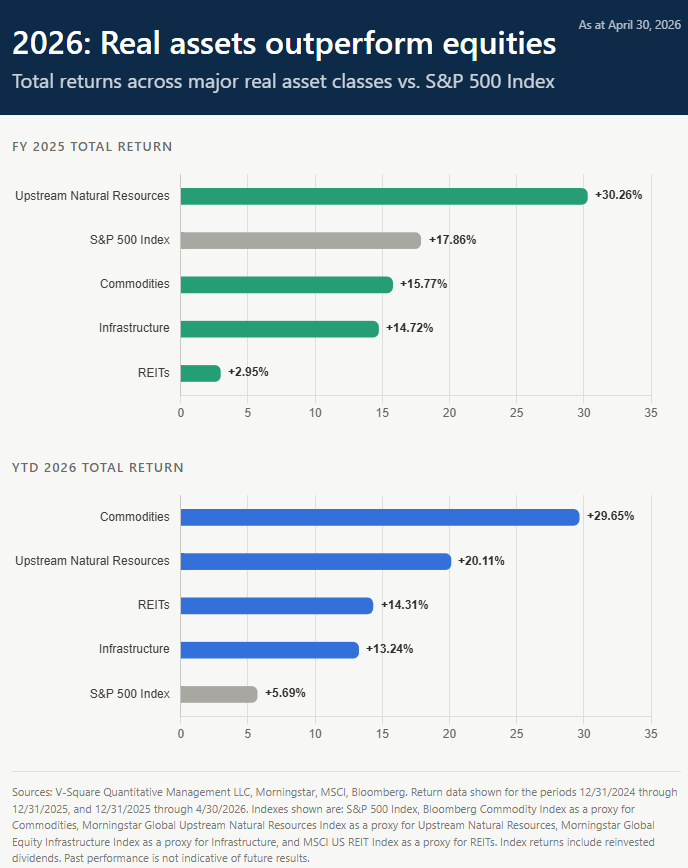
Year-to-April 30th, 2026, real asset index returns including Commodities +29.65%, Upstream Natural Resources +20.11%, REITs +14.31%, Infrastructure +13.24%. The S&P 500 Index is at +5.69%.
We think that the story behind these YTD numbers is more interesting than the numbers themselves. The new question is how to include real assets in an allocation, rather than whether to include them.
First, this is not a one-quarter rotation. In the full year 2025, Upstream Natural Resources Indexes were up 30.26% versus the S&P 500 Index which ended the year up 17.86%. What has changed in 2026 is breadth of real asset segments displaying strong performance. REITs went from a 2025 laggard at +2.95% to a leading sector in 2026, at a +14.31% return.
Second, real assets are doing exactly what the 60/40 stopped doing. With the correlation of equity and bond returns now at elevated levels, traditional diversification has thinned out at precisely the moment investors need it most. Real assets fill that gap with return drivers that are structurally distinct from duration and equity risk premia
Third, the macro backdrop of increasing demand underlying real assets is expected to be multi-decade. McKinsey puts global infrastructure investment needs at $106 trillion through 2040. Energy and computing demands continue to accelerate as the supply constraints of critical materials remain structural.
What does it mean for portfolio?
We believe real assets are a natural fit for systematic, rules-based implementation. Real assets is a broad, heterogeneous category spanning commodities, listed real estate, natural resources, and infrastructure. Each subsector has distinct return drivers, risk profiles, and sensitivities to macro factors. Consistently capturing the strategic exposure of this asset class is where a disciplined, factor-aware framework adds value making it a good fit for systematic, rules-based implementation.
Both fundamental and systematic approaches have a place in real asset allocations. The systematic lens is designed to create a durable, diversified exposure to the asset class itself whilst fundamental approaches are often geared towards more concentrated views on specific sub-segments of the asset class.
How are you implementing real assets allocations today?
Source: V-Square Quantitative Management LLC, Morningstar, MSCI, Bloomberg. Return data shown for the periods 12/31/2024 through 12/31/2025, and 12/31/2025 through 4/30/2026. Indexes shown are: S&P 500 Index, Bloomberg Commodity Index as a proxy for Commodities, Morningstar Global Upstream Natural Resources Index as a proxy for Upstream Natural Resources, Morningstar Global Equity Infrastructure Index as a proxy for Infrastructure, and MSCI US REIT Index as a proxy for REITs.
This chart is for illustrative purposes only. Other indexes are available. It is not possible to invest directly in an index. Index returns do not reflect any management fees, transaction costs or expenses. Past performance does not guarantee future performance. The information and opinions contained herein are for informational purposes only, do not purport to be full or complete, do not constitute investment advice and may not be relied on. For more information, please see vsqm.com/disclaimer.