
The University of Michigan just won the NCAA Championship🏀. So, what better time to check in on another of Michigan’s flagship productions?
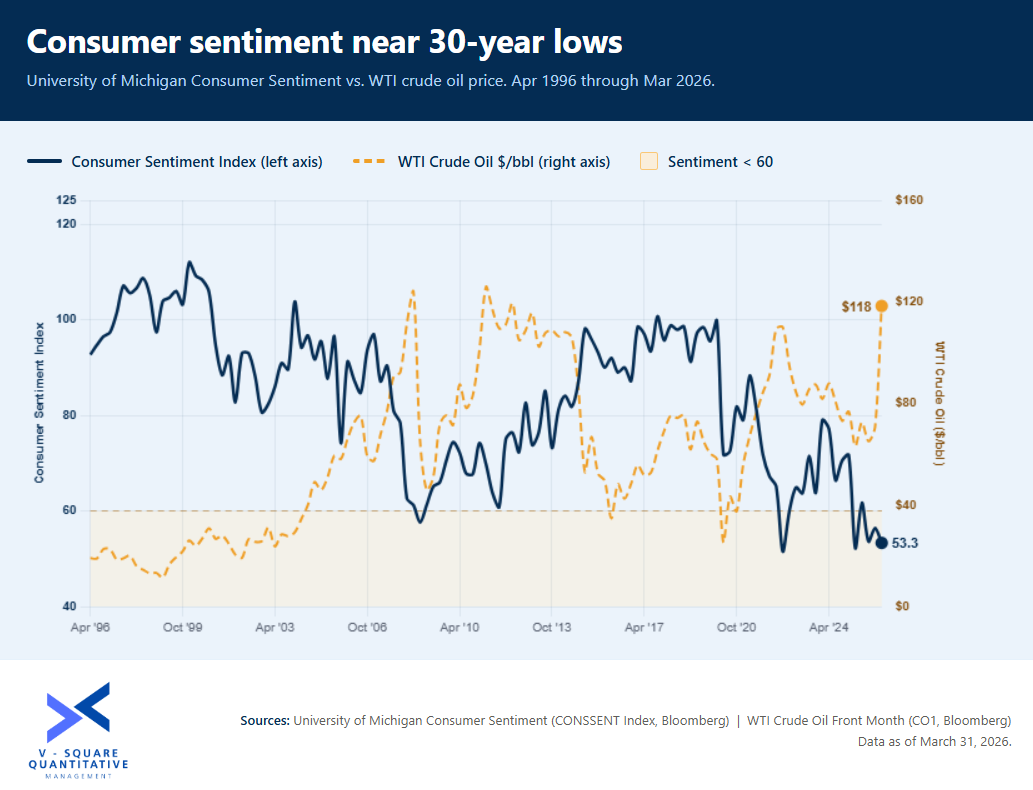
The University of Michigan’s Consumer Sentiment Index for the US was 53.3 on March 31, 2026.
That score deserves a moment of pause. Whilst lower than the trough of the 2008 Financial Crisis and lower than the months following September 11, 2001, it also sits 37% below the 30-year average of 84.3. This is despite 2026’s full employment, rising GDP, and equity markets that have more than doubled since their COVID bottom.
By every conventional measure, the economy is fine. Yet sentiment amongst American consumers bemoans a different picture, sitting near long-term historical lows.
We believe that this contradiction is a signal rather than merely a data anomaly.
The wealth effect doesn’t affect everyone equally. As the top 10% of Americans own ~93% of equities, when the S&P 500 Index rallies, a family managing a tight grocery budget don’t feel the uplift. Conversely, when gas prices spike, the impact is felt by everyone at the pump. The 30-year correlation between energy prices and consumer sentiment is -0.57. The economic reality, for most people, lives at the pump, not in a portfolio statement.
Weak consumer sentiment is not just a reflection of conditions, it shapes them. Consumers who feel poor spend less, borrow less, and take fewer risks.
For investors, the case for quality, value, and dividend yield is strengthened. Strategies where returns do not require consumers to feel better, only for companies to keep generating cash will likely be rewarded in the long term.
What do you think could make consumer sentiment improve? How do you consider consumer sentiment in your portfolio?
Source: V-Square Quantitative Management LLC, Bloomberg, University of Michigan Consumer Sentiment Report. Monthly data from 4/30/96 through 3/31/26.
This chart is for illustrative purposes only. Other indexes are available. It is not possible to invest directly in an index. Index returns do not reflect any management fees, transaction costs or expenses. Past performance does not guarantee future performance. The information and opinions contained herein are for informational purposes only, do not purport to be full or complete, do not constitute investment advice and may not be relied on. For more information, please see vsqm.com/disclaimer.