
Wishing everyone a Happy Fourth of July. As America celebrates its 250th anniversary, we thought it was a fitting moment to reflect on the long-term economic picture.
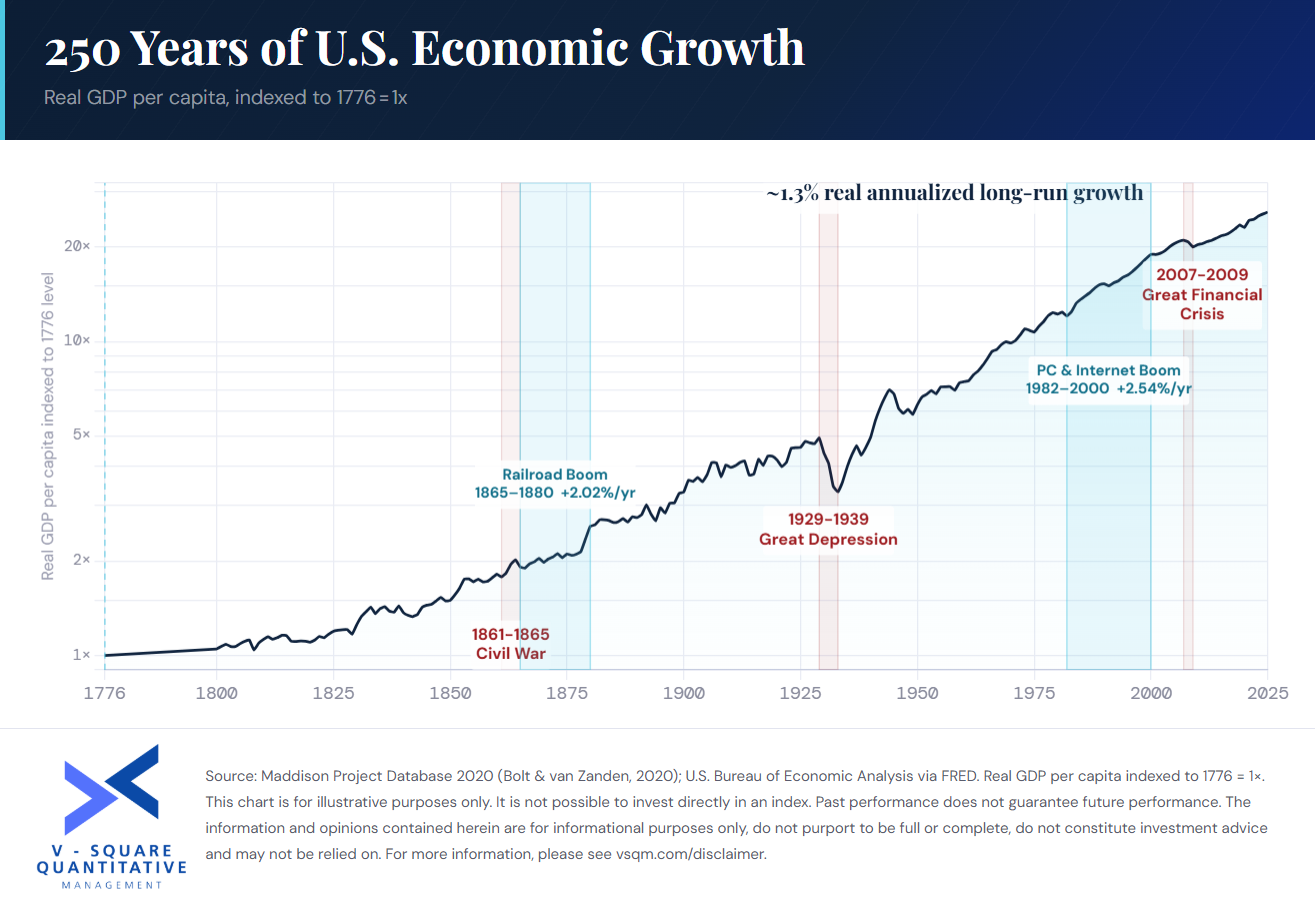
The chart below displays U.S. real GDP per capita since founding, drawing on data from the Maddison Project and the U.S. Bureau of Economic Analysis, two of the most widely cited sources in long-run economic history. Fragmented historical records and the absence of formal national accounting means that pre-1900 estimates carry more uncertainty, however the directional story is consistent across sources: real GDP per capita has grown materially since independence, showing a long-run annualized growth rate of ~1.3% per year in real terms.
The growth was not linear; new technologies repeatedly reshaped the trajectory. The railroad boom (mid-to-late 1800s), the PC era (1980s) and the internet era (1990s) each drove measurable periods of growth. The Great Depression (1930s) stands apart a significant period of decline which can be seen clearly, even on a 250-year scale.
For investors, we see a couple of takeaways that endure across all 250 years.
First, remaining invested matters. The long-run trend of economic growth is a powerful force, and time in the market is how investors can capture growth.
Second, technological innovation is a key driver of growth.
What do you think will be the greatest innovation of the next 25 years, and how will you incorporate this into your portfolio? Share your thoughts below!
Source: Maddison Project Database 2020 (Bolt & van Zanden, 2020); U.S. Bureau of Economic Analysis via FRED. Real GDP per capita indexed to 1776 = 1×.
This chart is for illustrative purposes only. Other indexes are available. It is not possible to invest directly in an index. Index returns do not reflect any management fees, transaction costs or expenses. Past performance does not guarantee future performance. The information and opinions contained herein are for informational purposes only, do not purport to be full or complete, do not constitute investment advice and may not be relied on. For more information, please see vsqm.com/disclaimer.