
Two intuitive beliefs resurface every World Cup; that hosting enriches the host nation and that winning lifts the home market.
In economists’ view, neither of these claims consistently find the back of the net. Economists find the measurable effect on the host nation's output is marginally positive at best and statistically indistinguishable from zero at worst. The benefit of lucrative broadcasting and sponsorship deals accrues to global rights holders rather than to the host nation. FIFA and the WTO project roughly $40.9 billion in economic contribution across the three host nations for 2026, a figure independent economists treat with considerable skepticism.
Winning a Word Cup fares little better for the home nation since the modest GDP bump some studies identify has proved difficult to reproduce from one tournament to the next over the past four decades.
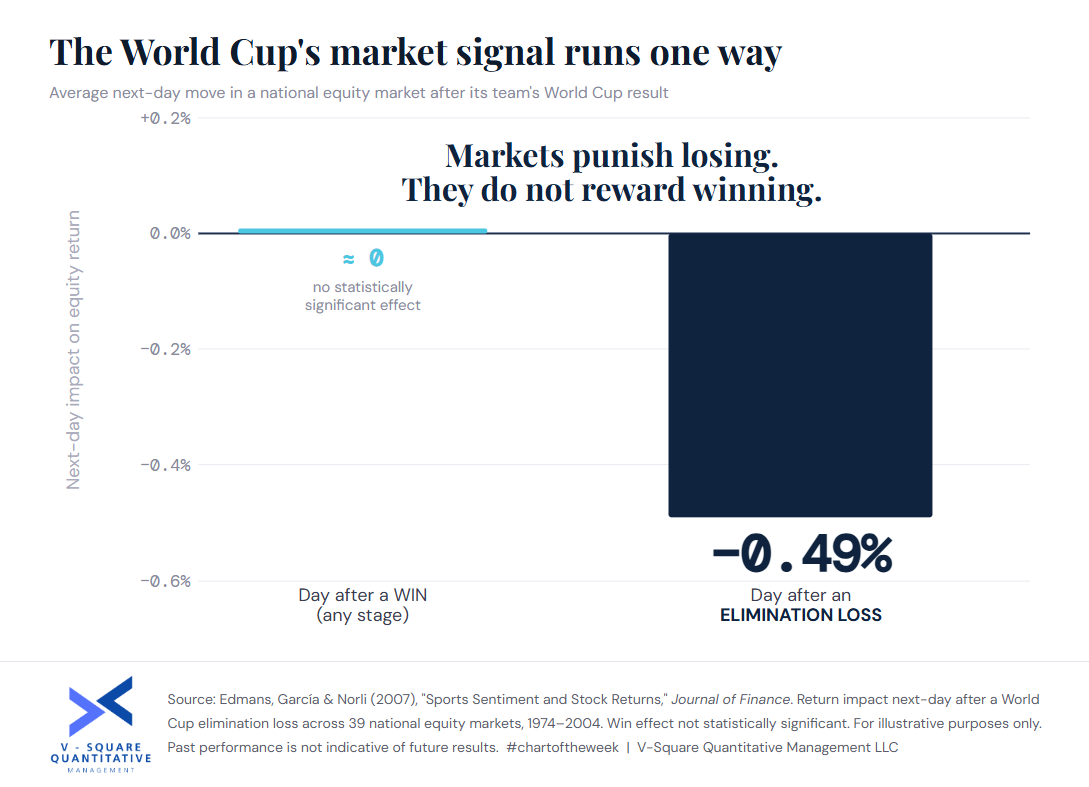
The single result that does seem to register in markets sits in investor sentiment. The commonly cited study by Edmans, García and Norli in the Journal of Finance, found that a country's market falls close to half a percent the day after an elimination loss; while surviving elimination with a win produces no measurable gain at all.
There is no known link between a knockout and the performance of the listed companies of the losing nation; so what moves the market is the collective mood of millions of investors, especially when their home team goes out.
A rules-based process is built to withstand these weak signals of sentiment. This is why at V-Square we set our factor rules in advance, protecting portfolios from the power of sentiment.
Do you think the World Cup will impact investor sentiment in 2026?
Source: Edmans, García & Norli (2007), "Sports Sentiment and Stock Returns," Journal of Finance. Return impact next-day after a World Cup elimination loss across 39 national equity markets, 1974–2004. Win effect not statistically significant. FIFA is the Fédération Internationale de Football Association, also known as the International Federation of Association Football. WTO is the World Trade Organization.
This chart is for illustrative purposes only. Other indexes are available. It is not possible to invest directly in an index. Index returns do not reflect any management fees, transaction costs or expenses. Past performance does not guarantee future performance. The information and opinions contained herein are for informational purposes only, do not purport to be full or complete, do not constitute investment advice and may not be relied on. For more information, please see vsqm.com/disclaimer.