
Did You Get Your Midterm Results?
Anyone who has waited on midterm results knows the next question arrives almost immediately: what does this mean for the finals?
Democrats are projected to control both chambers of Congress, securing at least 54 Senate seats and a House majority. Their gains extended into Republican strongholds, including the first Democratic Senate victory in Texas in 38 years, alongside flips in Kansas and South Carolina.
Wall Street welcomed the results on Wednesday: equities rallied, Treasury yields fell, and the dollar weakened as investors priced in tighter limits on fiscal expansion.
By Thursday, the celebration was over.
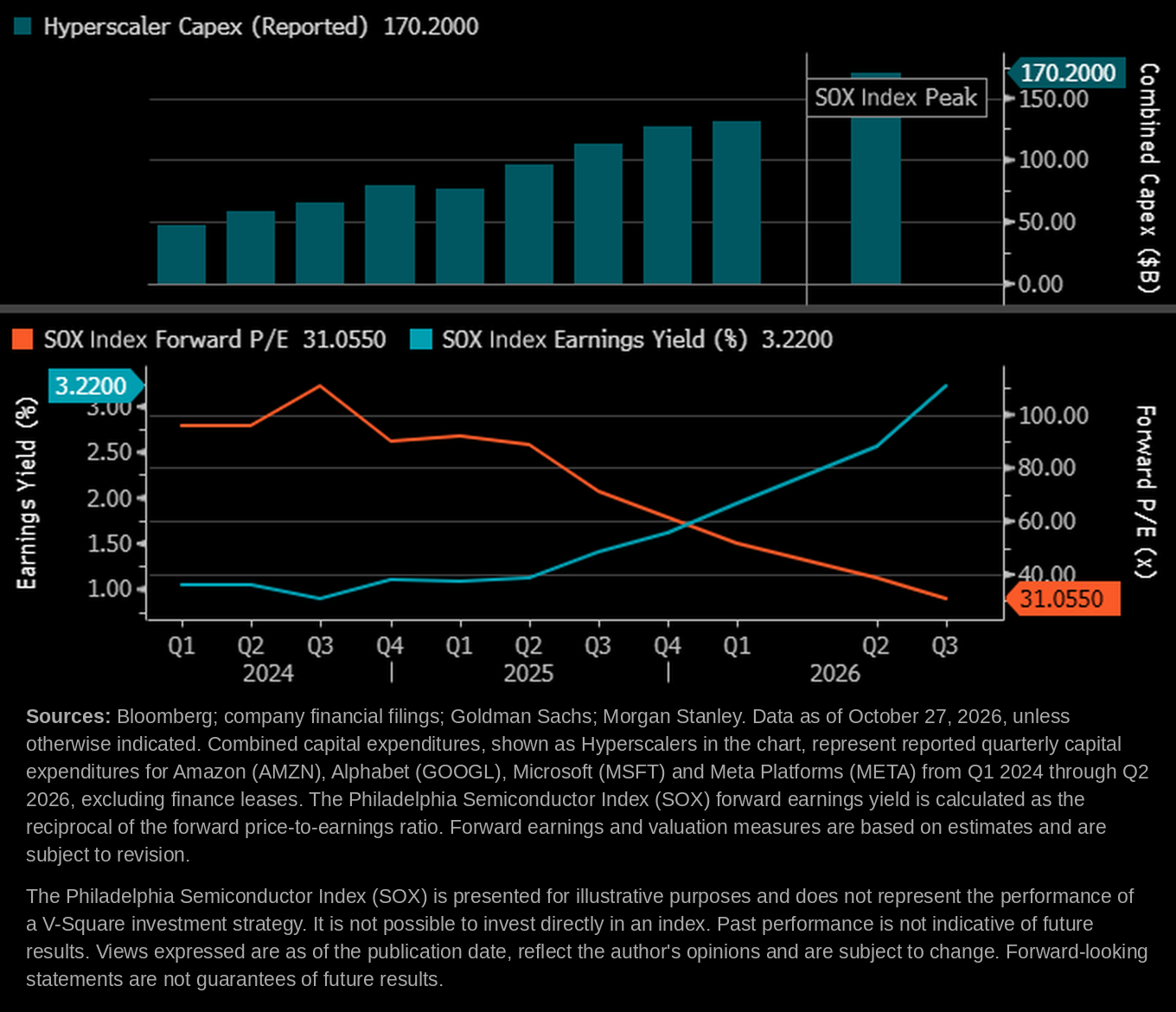
The S&P 500 Index plunged 4.4%, the Nasdaq Composite Index lost 5.5%, and the Philadelphia Semiconductor Index (SOX) fell approximately 12%. The post-election relief rally evaporated as investors reassessed the implications of political change for the artificial intelligence investment cycle.
The reversal raises an important question: can the historical post-midterm market rally withstand today's elevated valuations, restrictive borrowing costs, and growing uncertainty surrounding AI capital expenditures?
The Midterm Effect: History Offers a Remarkable Pattern
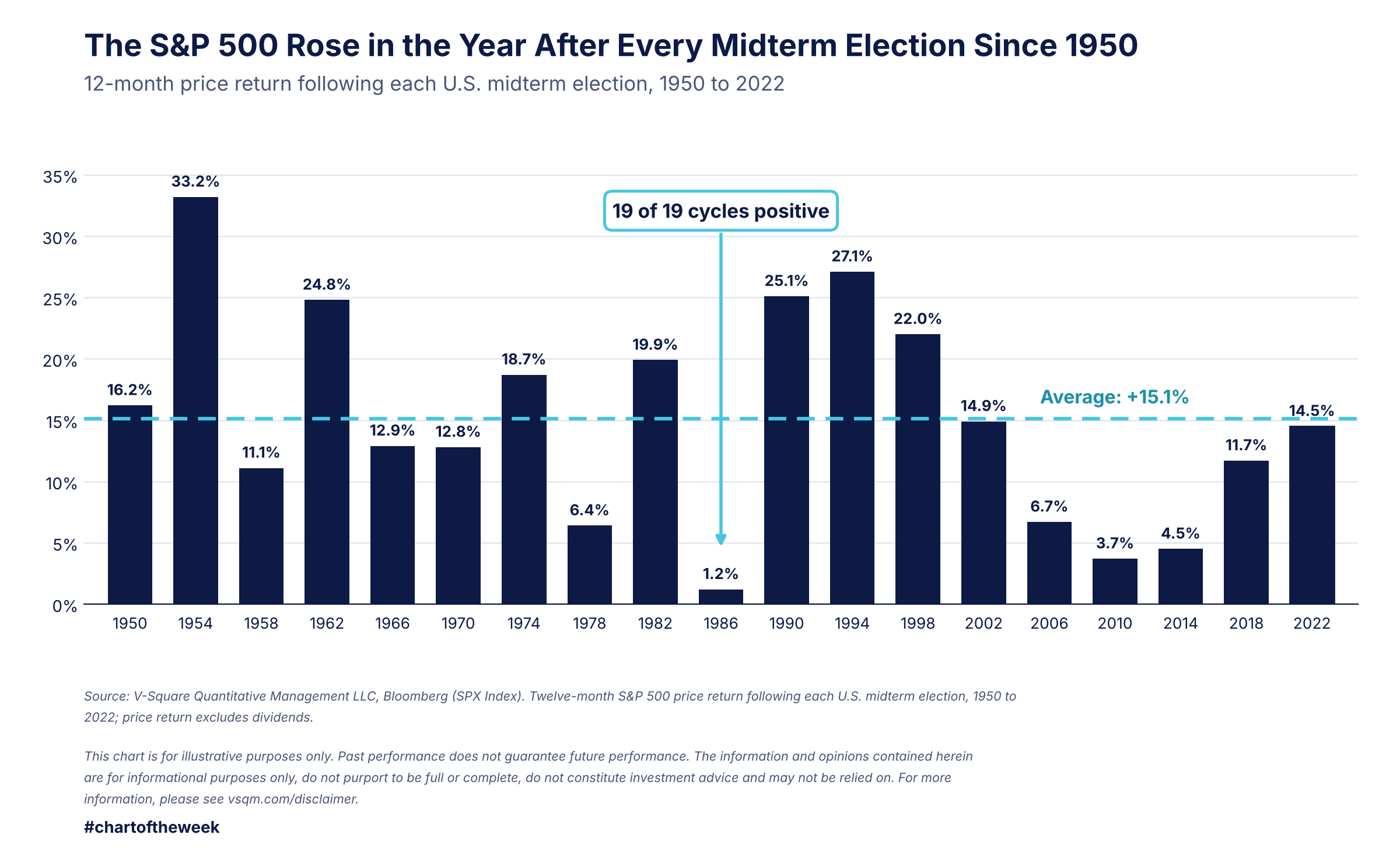
Here is a striking historical fact: since 1950, the S&P 500 Index has generated positive returns in the 12 months following every US midterm election, regardless of which party controlled Congress or the White House.
As illustrated in this week's chart, the average gain across these 19 election cycles was approximately 15.1%, with positive returns in every observation.
A few weeks ago, on Bloomberg Businessweek ,Carol Massar and Tim Stenovec asked me how the midterms might affect markets. My view was straightforward: once political uncertainty clears, investors refocus on corporate earnings, monetary policy, and the economic cycle.
Thursday's selloff provides an immediate reminder of that principle.
Historical patterns can offer useful perspective, but the path matters as much as the destination. Markets can experience substantial drawdowns within an otherwise positive 12-month period.
And today's economic starting point deserves particular attention.
The Fiscal Equation Has Changed
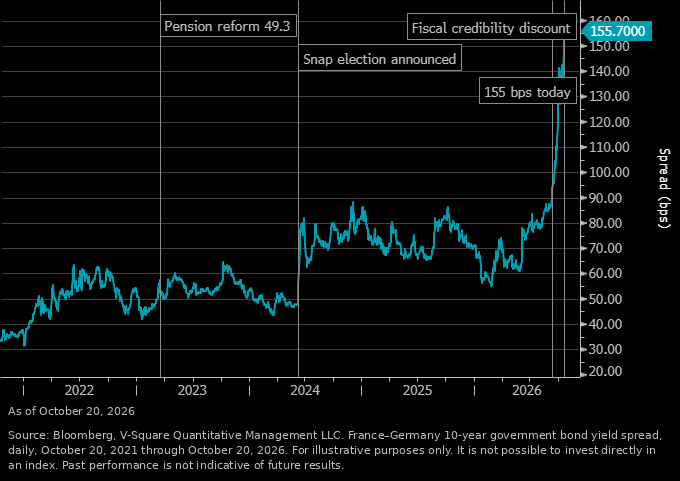
The Democratic sweep, the Blue Wave, introduces a significant constraint on the current administration's fiscal agenda.
Additional tax cuts, spending initiatives, and deficit-financed stimulus will likely face greater congressional resistance. For a US bond market already confronting elevated Treasury issuance, rising debt-servicing costs, and long-term yields near 5%, this shift could prove consequential.
The 10-year US Treasury yield declined to approximately 4.84% on Thursday, extending Wednesday's bond-market rally.
However, lower yields require careful interpretation. Expectations of fiscal restraint may be contributing, alongside falling equity prices, shifting growth expectations, and demand for safer assets.
A divided government also carries its own risks. Budget negotiations, government shutdowns, and debt-ceiling confrontations could introduce new volatility. Political gridlock may slow fiscal expansion without meaningfully improving the trajectory of US debt.
This brings us back to a theme we explored in “The Price of Conviction” when US government bonds offered yields approaching 5%, the hurdle for taking additional investment risk becomes considerably higher.
Washington may be entering a period of political gridlock. The US bond market will continue to demand fiscal discipline.
The AI Investment Cycle Faces Its First Political Reckoning
Perhaps the most consequential market development following the election has occurred in the Technology sector.
Thursday's sharp selloff in Semiconductors and AI infrastructure companies reflects growing concerns that political and regulatory constraints could slow the expansion of data-center capacity.
Nvidia declined approximately 9%, while the SOX Index fell 12%, one of its largest daily declines on record.
The selloff reinforces the capital allocation concerns highlighted in our recent Chart of the Week, The AI Capital Allocation Reckoning: Markets Just Blinked.
Important Disclosures
This material is provided for informational and illustrative purposes only and does not constitute investment advice or a recommendation to buy or sell any security. The views expressed reflect market conditions as of November 5, 2026, and are subject to change without notice. Forward-looking statements and market expectations involve uncertainty, and actual outcomes may differ materially.
Historical index performance is provided for illustrative purposes only. Past performance is not indicative of future results. Investors cannot invest directly in an index. Index returns do not reflect management fees, transaction costs, or expenses, which would reduce investment returns. Historical market patterns, including post-midterm election performance, do not guarantee future outcomes.
Individual client accounts will vary. Investment advisory fees are described in V-Square Quantitative Management LLC's Form ADV Part 2A.
© V-SQUARE QUANTITATIVE MANAGEMENT LLC | vsqm.com/disclaimer
This chart is for illustrative purposes only. Other indexes are available. It is not possible to invest directly in an index. Index returns do not reflect any management fees, transaction costs or expenses. Past performance does not guarantee future performance. The information and opinions contained herein are for informational purposes only, do not purport to be full or complete, do not constitute investment advice and may not be relied on. For more information, please see vsqm.com/disclaimer.