
Chair Warsh’s observation is particularly relevant to the AI infrastructure investment cycle. As capital commitments expand, financing conditions and the returns investors demand are becoming increasingly important to the economics of the buildout.
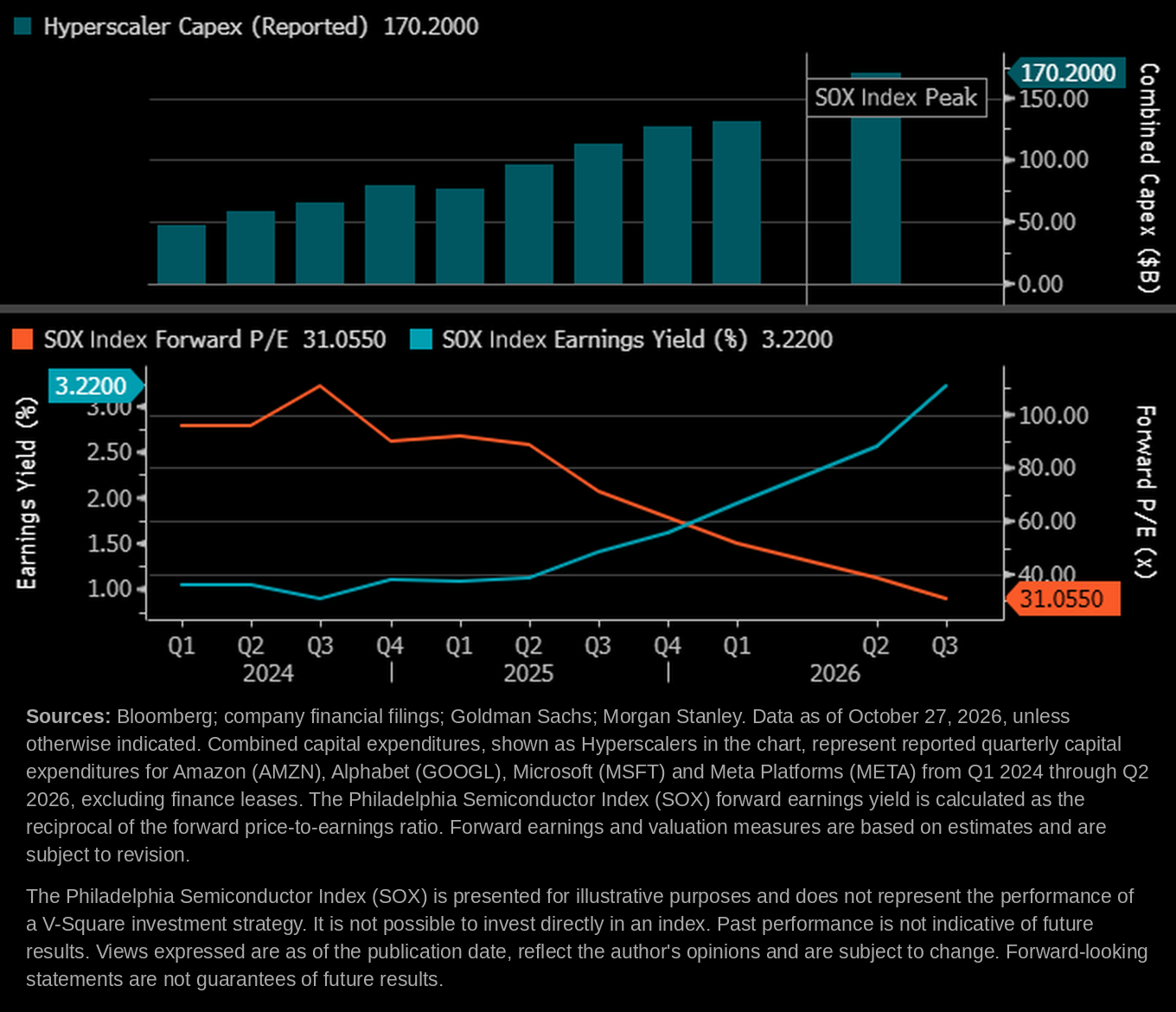
Amazon, Alphabet, Microsoft and Meta are undertaking one of the largest parallel infrastructure investment cycles in corporate history. Their combined quarterly capital expenditures have more than tripled since early 2024, driven by the race to build artificial intelligence capacity.
Yet the Philadelphia Semiconductor Index (SOX), after reaching a record high on June 22, 2026, had fallen approximately 24% through October 26, 2026. The index returns remain higher year-to-date, but the change in direction is striking.
The chart captures an emerging divergence between corporate investment and the valuations investors assign to semiconductor earnings.
The question the chart raises
Hyperscaler investment, meaning investment into cloud computing, networking, and storage services, has accelerated while semiconductor valuation multiples have compressed. Investors appear increasingly focused on a fundamental question: What return will this extraordinary capital deployment generate?
The valuation dimension is particularly revealing. Between Q1 2024 and Q2 2026, the SOX Index forward earnings yield increased from approximately 1% to 2.6%, reflecting substantial multiple compression, even as implied forward earnings increased over the period.
Investors are demanding a higher prospective earnings yield from semiconductor equities. Whether this reflects concerns about the durability of future growth, returns on invested capital, or competition from higher Treasury yields remains an important question.
Meanwhile, hyperscaler spending plans remain substantial. Goldman Sachs estimates that major US hyperscalers could invest approximately $1.1 trillion in 2027.
I see a consequential dynamic emerging. At this scale, infrastructure spending may reflect competitive necessity as much as confidence in future returns.
Each hyperscaler faces a rational incentive to invest aggressively. Falling behind in AI infrastructure could permanently weaken its competitive position, both domestically and globally. Collectively, however, those decisions may produce more capacity than the market can absorb profitably in the near term.
The distinction matters for investors: rational capital allocation at the company level does not necessarily produce attractive returns at the industry level.
The infrastructure boom that history remembers differently
The late-1990s telecommunications boom offers a useful historical perspective. Fierce competition encouraged enormous investment in fiber-optic networks, ultimately contributing to excess capacity and substantial shareholder losses.
Today's hyperscalers have established revenues, significant cash flows and competitive advantages that many telecommunications overbuilders lacked.
The economic incentive nonetheless warrants comparison. Once an infrastructure race accelerates, individual participants may struggle to moderate investment even as industry-wide returns deteriorate.
I would therefore caution that the scale of AI infrastructure investment increasingly resembles earlier infrastructure booms, carrying substantial opportunities alongside financial risks.
The lesson extends beyond the possibility of a speculative bubble. Transformative technologies can create enormous economic value while delivering disappointing returns to some of the companies financing their development.
What the bond market is telling us
US investment-grade corporate bond issuance reached approximately $1.76 trillion in October 2026, surpassing the previous annual record established during the pandemic. AI infrastructure financing has become an increasingly important component of corporate credit supply.
Meanwhile, analysis of major technology companies' financial disclosures identifies approximately $3 trillion in off-balance-sheet commitments, including future equipment purchases, leases and other contractual arrangements. These commitments represent future financial obligations, although they should not be confused with outstanding debt.
This introduces another dimension to the AI investment cycle: the cost and availability of capital.
As I wrote three weeks ago, when the 10-year US Treasury yields above 5%, every dollar of capital must earn its place in a portfolio.
Higher financing costs raise the investment hurdle. Depreciation, expanding infrastructure requirements and growing contractual commitments make the economics of incremental investment increasingly important.
The impact will vary across the AI ecosystem. Large hyperscalers retain substantial operating cash flows and balance-sheet flexibility, while leveraged infrastructure developers depend more heavily on external financing.
The bond market could become an important mechanism through which the pace of AI infrastructure expansion is disciplined.
The portfolio implication
For multi-asset portfolios, the divergence between capital spending and semiconductor valuations reinforces a broader principle: corporate investment conviction and shareholder returns are governed by different economics.
As the investment cycle matures, I expect greater dispersion in returns across the AI ecosystem. Capital efficiency, earnings conversion and the ability to sustain returns on incremental invested capital should become increasingly important considerations in security selection.
Investors will need to assess how much future growth is already embedded in valuations, the capital required to deliver that growth, and the durability of the resulting economic returns.
These considerations have implications for portfolio concentration, factor exposures and capital allocation across the broader technology ecosystem.
The AI infrastructure investment cycle remains significant. Its ultimate distribution of profits is far less certain at this early stage.
Sources: Bloomberg; company financial filings; Goldman Sachs; Morgan Stanley. Data as of October 27, 2026, unless otherwise indicated. Combined capital expenditures, shown as Hyperscalers in the chart, represent reported quarterly capital expenditures for Amazon (AMZN), Alphabet (GOOGL), Microsoft (MSFT) and Meta Platforms (META) from Q1 2024 through Q2 2026, excluding finance leases. The Philadelphia Semiconductor Index (SOX) forward earnings yield is calculated as the reciprocal of the forward price-to-earnings ratio. Forward earnings and valuation measures are based on estimates and are subject to revision.
The Philadelphia Semiconductor Index (SOX) is presented for illustrative purposes and does not represent the performance of a V-Square investment strategy. It is not possible to invest directly in an index. Past performance is not indicative of future results. Views expressed are as of the publication date, reflect the author's opinions and are subject to change. Forward-looking statements are not guarantees of future results.
This chart is for illustrative purposes only. Other indexes are available. It is not possible to invest directly in an index. Index returns do not reflect any management fees, transaction costs or expenses. Past performance does not guarantee future performance. The information and opinions contained herein are for informational purposes only, do not purport to be full or complete, do not constitute investment advice and may not be relied on. For more information, please see vsqm.com/disclaimer.