
As a French citizen who grew up in France, a product of its education system and an investor who assesses risk for a living, the current unrest pains me on both a personal and professional level. I owe much to the opportunities France gave me.
I left France 22 years ago. Who am I to offer advice from abroad? This is a fair question, however I believe that distance brings perspective, whilst I acknowledge that this distance also means I do not experience the daily consequences of the policies I discuss. Yet, I love France too much to remain silent about its future.
France has a growth problem, compounded by a pension financing problem and magnified by an employment challenge. All three sit within a social and institutional framework increasingly overdue for renewal. Weak growth constrains revenues, insufficient employment limits retirement contributions, and an aging population increases the demands placed on both.
The numbers reveal how little room there is for delay. The European Commission's Spring 2026 forecast puts real growth at 0.8% in 2026 and 1.1% in 2027, while unemployment is predicted to reach 8.7% and public debt rises to 120.2% of GDP in 2027.
The Chart
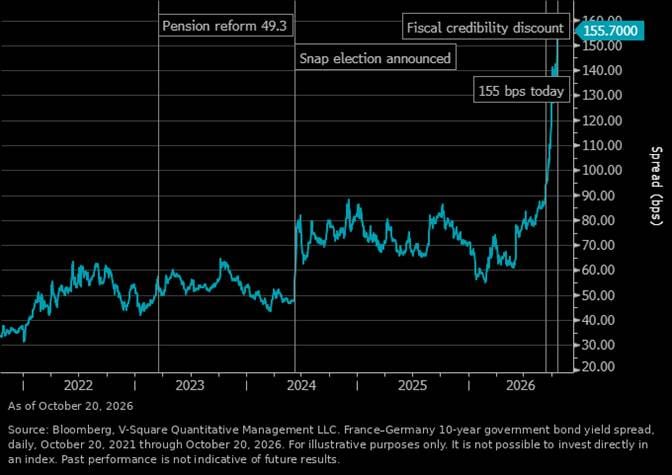
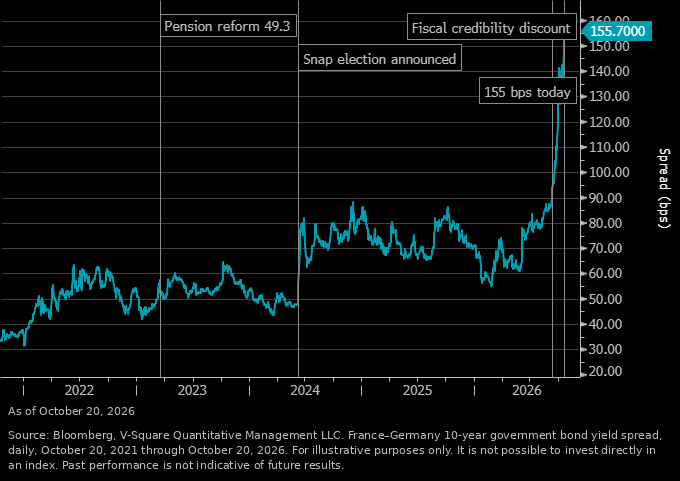
The France-Germany 10-year yield spread is, to me, a direct real-time measure of what France's fiscal inaction costs, every day, on every bond it issues. The France-Germany 10-year yield spread has widened from ~34 bps in October 2021 to 156 bps on October 20, 2026, a fourfold increase consistent with political fragmentation in June 2024 marked by the Snap Election and, more recently, concern over France's fiscal trajectory marked by France’s Fiscal Credibility Discount. At a debt ratio near 120% of GDP, this spread is the premium France pays over Germany each time it refinances.
Three acts are visible in the data:
· 2021 to early 2024 (~34 bps to 55 bps): A stable, low-spread regime. Markets treated France as a core Eurozone credit with modest risk premium.
· June 2024 (~48 bps to 82 bps): The snap election announcement was followed by an immediate repricing. Political fragmentation became a market event overnight.
· September 2026 and October 2026 (82 bps to 156 bps today): The spread nearly doubled since the election shock of June 2024 with broken to multi-year highs. To me, this reads as a fiscal credibility discount layered on top of the earlier political premium.
The Constraint Is Tightening
French Government interest payments are projected to rise from 2.0% of GDP in 2024 to 2.8% in 2027, a 40% increase in their share of national output. This increase absorbs resources that could otherwise support public services, investment, or household relief.
The projected 2027 deficit of 5.7% of French GDP implies a deficit of approximately 2.9% of GDP before interest payments. Lower borrowing costs alone would leave a substantial financing gap.
At a debt ratio near 120% of GDP, a sustained one-percentage-point deterioration in the gap between the effective interest rate and the growth rate adds roughly 1.2% of GDP to the debt ratio each year, before the budget balance, excluding interest and other adjustments. Refinancing determines how quickly higher market yields feed into that calculation.
Social unrest raises the risk that these fiscal projections are not delivered. A budget assumes that measures will be implemented and sustained. Public opposition, parliamentary fragmentation, and policy reversals can undermine that assumption. Abrupt retrenchment can also weaken demand and intensify the grievances that make fiscal adjustment difficult.
A Path Forward
If I were advising President Macron, I would put growth and employment at the center of the response. France faces a Catch-22: weak growth makes its commitments harder to finance, while fiscal tightening can weaken activity and deepen the resistance to reform.
The talent within France’s universities, business schools and research capabilities provide a strong foundation for reform. The priority should be to translate more of that talent into businesses that scale, productive investment and employment. Predictable rules and business regulations and stronger links between research and industry would help move France closer to true reform.
AI offers an opportunity to accelerate innovation and productivity. I would redirect existing training budgets toward employer-linked AI-focused retraining, with businesses sharing the cost. With unemployment at 8.3%, the transition must also help young people enter the workforce and also support experienced workers adapt to new technologies before they are displaced from the workforce.
Given France’s contentious history of pension and benefit reform, I would suggest a focus on strengthening the productive base that finances those retirement commitments, alongside spending discipline. Borrowed time, meaning a slower pace of adjustment, should produce a greater capacity to generate growth, employment and opportunity.
The Investor Takeaway
For investors, the central question is whether France can improve its budget balance, before including the impact of interest payments, while preserving growth. The French-German yield spread deserves attention alongside the outright yield. Longer maturities expose investors to fiscal choices spanning successive governments. A higher yield becomes attractive when it adequately compensates for that uncertainty.
France needs a durable agreement on work, growth, and the financing of its commitments. I want the opportunities that shaped me to endure, and I believe a credible path to preserving those opportunities would be among the strongest signals France could send to markets.
Source: Bloomberg, V-Square Quantitative Management LLC. France–Germany 10-year government bond yield spread, daily, October 20, 2021 through October 20, 2026. For illustrative purposes only. It is not possible to invest directly in an index. Past performance is not indicative of future results.
This chart is for illustrative purposes only. Other indexes are available. It is not possible to invest directly in an index. Index returns do not reflect any management fees, transaction costs or expenses. Past performance does not guarantee future performance. The information and opinions contained herein are for informational purposes only, do not purport to be full or complete, do not constitute investment advice and may not be relied on. For more information, please see vsqm.com/disclaimer.