
The next percentage point of disinflation may prove considerably more expensive than the last.
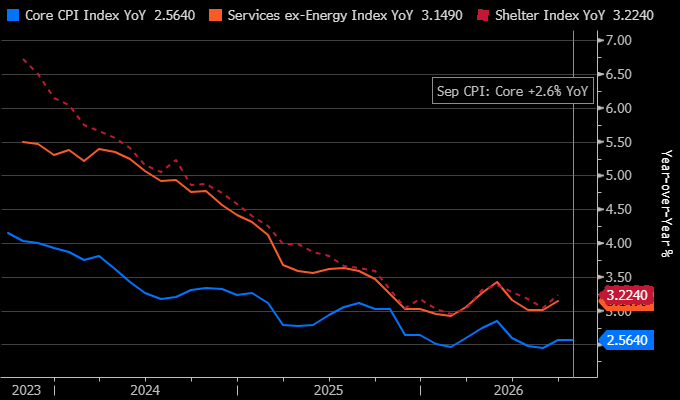
The Core CPI year-over-year change has declined from 4.0% in October 2023 to 2.6% in September 2026. Over the same period, Services inflation excluding Energy has fallen from approximately 5.5% to 3.1%;progress for both of these measures has stalled in recent months.
The first phase of disinflation in October 2023 benefited from the unwinding of exceptional price pressures. Supply Chains normalized, Consumer Goods prices moderated, and Shelter Inflation gradually caught up with conditions in the rental market.
Much of that adjustment occurred without a corresponding contraction in economic activity.
The economics of the next phase, from October 2026 onwards, looks different.
The marginal cost of disinflation
With Shelter Inflation down to 3.2% in September 2026, and Services prices proving persistent, the remaining adjustment increasingly depends on domestic demand, labor costs, and productivity.
That raises a critical question: how much economic weakness would be required to reduce inflation by another percentage point?
There is no fixed answer. But the disinflation delivered by Supply normalization cannot simply be repeated. Indeed, we believe that further progress may require a more pronounced adjustment in the real economy unless productivity growth provides an offset.
This changes the monetary-policy calculus.
The asymmetry facing the Fed
An economy with resilient growth and persistent Services inflation offers limited justification for aggressive monetary easing.
An economy with weakening growth and persistent Services inflation presents a considerably harder problem. In this scenario, the Fed's traditional ability to cushion a slowdown becomes more constrained. For investors, this creates an important asymmetry: the inflation data may limit the upside from lower rates even as weaker growth increases downside risks to earnings.
The portfolio implication
The relationship between stocks and bonds deserves particular attention.
When economic growth is the dominant risk, U.S. Treasuries have historically provided valuable diversification during equity drawdowns. When inflation is the dominant risk, rising discount rates can pressure both equity and fixed income asset classes simultaneously.
The distinction is consequential for portfolios constructed around the assumption that bonds will consistently offset equity weakness.
Looking toward 2027, investors should evaluate diversification through the interaction of growth, inflation, and interest-rate sensitivity, rather than relying exclusively on long-term historical correlations, though these relationships don’t always hold.
The bottom line
Whilst the first phase of disinflation was supported by normalization, the next may require a more difficult economic adjustment.
The investment risk is that growth weakens before inflation falls sufficiently. This could leave the Fed with little room to respond and make further progress on reducing inflation to their 2% target.
If we see the economy weaken before inflation reduces to target, that could result in elevated inflation for an extended period, holding implications for investment portfolios.
Source: Bloomberg, Bureau of Labor Statistics, V-Square Quantitative Management. All data as of September 30, 2026, retrieved from the Bureau of Labor Statistics’ Consumer Price Index (CPI) Summary (released on October 14, 2026). For illustrative purposes only. It is not possible to invest directly in an index. Past performance is not indicative of future results.
This chart is for illustrative purposes only. Other indexes are available. It is not possible to invest directly in an index. Index returns do not reflect any management fees, transaction costs or expenses. Past performance does not guarantee future performance. The information and opinions contained herein are for informational purposes only, do not purport to be full or complete, do not constitute investment advice and may not be relied on. For more information, please see vsqm.com/disclaimer.