
Escalating tensions and military activity across the Middle East sent an immediate jolt globally, as financial markets opened the week of March 2nd, 2026, with oil prices surging and equities facing a selloff.
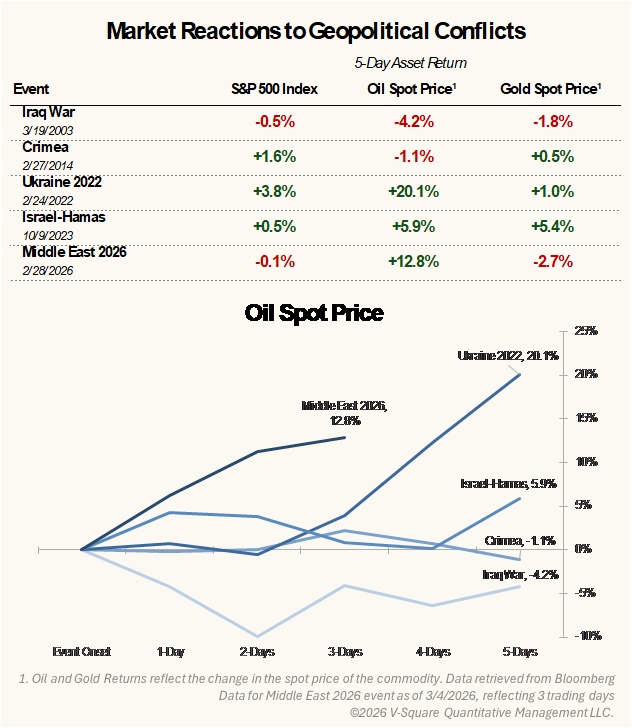
Looking back at major geopolitical conflicts over the past couple of decades, this reaction isn't surprising. In the past, Oil has tended to show increased price volatility when a conflict carries a credible threat to supply. The War in Ukraine (2022) was a stark example of this, with oil prices jumping more than +20% in the days following the invasion.
History also suggests is that these moves are often short-lived. As the initial shock fades, markets have often reverted, sometimes within just a few weeks of the trigger event.
How are you thinking about positioning in the current environment? We'd love to hear your thoughts.
Source: Bloomberg, V-Square Quantitative Management LLC, S&P Global. The chart displays the total return for the S&P 500 Index, Gold Spot Prices, and Crude Oil Barrel Prices (per West Texas Intermediate), for the five trading days following the onset of geopolitical crises. Middle East 2026 shows the 3 trading days following the onset of the geopolitical crisis.
This chart is for illustrative purposes only. Other indexes are available. It is not possible to invest directly in an index. Index returns do not reflect any management fees, transaction costs or expenses. Past performance does not guarantee future performance. The information and opinions contained herein are for informational purposes only, do not purport to be full or complete, do not constitute investment advice and may not be relied on. For more information, please see vsqm.com/disclaimer.