
When the risk-free rate rises, every investment has to earn its place in a portfolio.
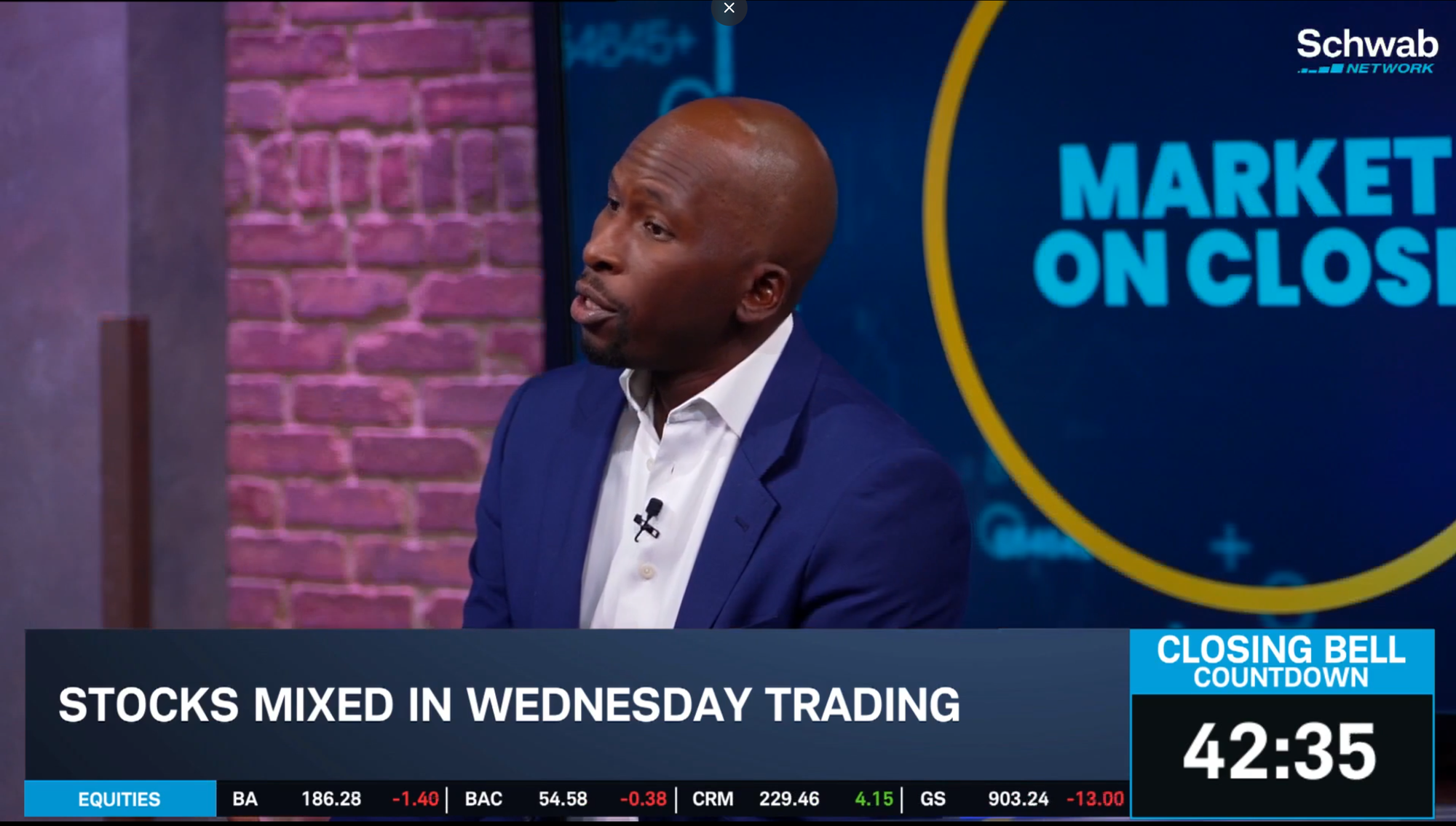
Last week on Schwab Network’s Market On Close, I shared my thoughts on whether growth could survive a higher cost of capital.
My view was that equities can remain resilient, particularly when earnings growth is strong. But a 10-year Treasury yield above 5% changes the investment equation. It raises the hurdle every investment must clear, and increases the importance of selectivity and true diversification within the broader investment portfolio.
Watch the Schwab Network discussion: “Can Growth Survive the Higher Cost of Capital?”
https://schwabnetwork.com/video/can-growth-survive-the-higher-cost-of-capital-
The cost of capital is becoming a more demanding judge of every investment. This week's chart puts a number behind that idea.
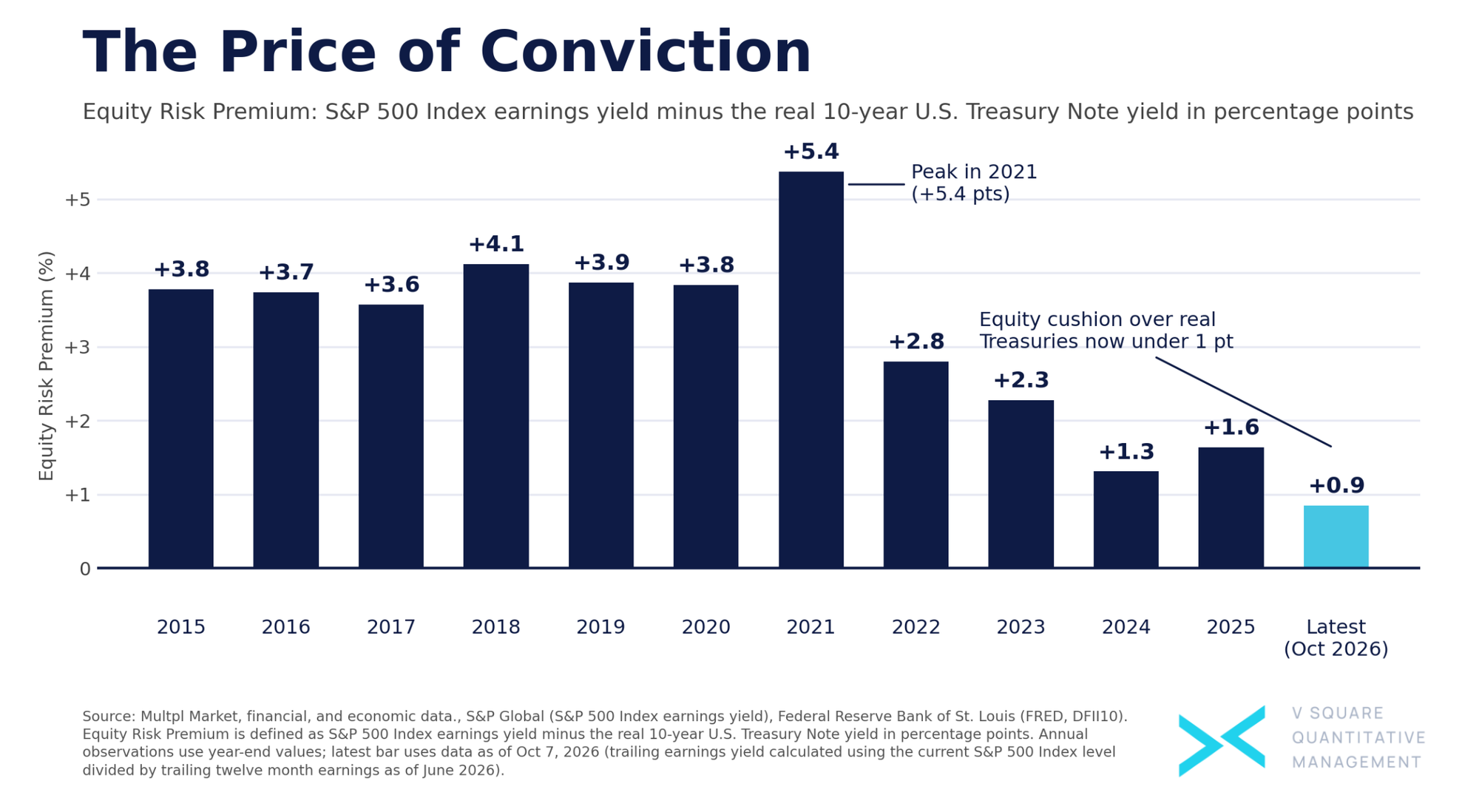
The chart below shows the difference between the S&P 500 Index earnings yield and the inflation-adjusted real yield on the 10-year U.S. Treasury Notes. I think of that gap as a simple price of conviction.
Ten years ago, the earnings yield on U.S. equities, as represented by the S&P 500 Index, sat notably higher than the real 10-year U.S. Treasury Note yield. Investors moving from government bonds into equities were receiving considerably more earnings yield in exchange for accepting greater risk.
That relationship changed dramatically in 2026.
With the 10-year U.S. Treasury Note now yielding above 5% (~2.9% in inflation-adjusted terms) and the S&P 500 Index earnings yield below 4%, the spread has moved from roughly 3.8% at the end of 2015 to just 0.9% in 2026. This gap represents an equity cushion illustrating the premium that investors demand for taking on equity risk.
Given how thin this cushion is today, investors are effectively paying elevated levels for earnings growth, in excess of inflation, that they expect will occur in future years. To me, this gap shows how much more every investment now has to deliver to earn its place in a portfolio. I believe that expectation is the conviction.
The hurdle rate has changed
When U.S. Treasury Notes yielded 1% or 2%, the opportunity cost of owning equities was relatively low. Notably, in 2021, low rates drastically lowered the cost of capital. Investors desire growth, but the “risk-free” alternative (U.S. Treasury Notes) offered very little return.
Today, an investor can earn more than 5% from a 10-year U.S. Treasury Note.
The 10-year U.S. Treasury Note carries price risk of its own, as last quarter's selloff showed. I use it here as a reference point for longer-dated risk.
Every incremental unit of risk has to compete against a starting point. For equities, earnings growth has to support valuations. For credit, spreads have to compensate investors for default and liquidity risk. For private markets, expected returns have to justify leverage, fees and illiquidity. And for the extraordinary amount of capital being committed to artificial intelligence, infrastructure and data centers, investors expect compensation via a translation from productivity into cash flow.
This is why earnings matter so much now
The interesting part of today's market is that equities have remained remarkably resilient despite the rise in yields.
There is a reason.
Corporate earnings are strong, and expectations surrounding AI-driven productivity remain powerful. Investors are effectively making a judgment that future earnings growth can clear a much higher hurdle rate.
That theory may prove correct.
Beneath the index, the picture is less uniform: in September the Dow Jones Industrial Average Index fell 4.3% while the Nasdaq Composite Index rose 1.9%, and 52-week lows outnumbered highs over the same period.
The margin for disappointment has changed.
At a 1.5% U.S. Treasury Note yield, an investor could afford to be patient with a distant earnings story.
At a 5% U.S. Treasury Note yield, patience has a price.
That rise in U.S. Treasury Note yield should make markets increasingly discriminating between companies that can convert investment into earnings and those relying primarily on multiple expansion.
From diversification to selectivity
There is another portfolio implication. Higher risk-free rates should increase the value of selectivity.
Simply owning more assets does not necessarily create diversification if those assets ultimately depend on the same underlying forces: falling rates, expanding valuations or abundant liquidity.
At V-Square, we look at diversification through factor exposures, because asset-class labels can hide shared risks.
Investors should ask a more fundamental question: What am I being paid to own this risk?
This question applies across public equities, fixed income, private markets and alternatives.
A thin premium doesn’t mean sell stocks. Equities offer growth that bonds cannot. Private investments can capture sources of return unavailable in public markets. Alternatives can introduce genuinely differentiated exposures.
When looking through the lens of factor exposures, the comparison begins from a very different place.
More than 5% yield is available from a 10-year U.S. Treasury Notes before taking many of those risks. I call it the new price of conviction.
Source: Multpl Market, financial, and economic data., S&P Global (S&P 500 Index earnings yield), Federal Reserve Bank of St. Louis (FRED, DFII10). Equity Risk Premium is defined as S&P 500 Index earnings yield minus the real 10-year U.S. Treasury Note yield in percentage points. Annual observations use year-end values; latest bar uses data as of Oct 7, 2026 (trailing earnings yield calculated using the current S&P 500 Index level divided by trailing twelve month earnings as of June 2026). For illustrative purposes only. It is not possible to invest directly in an index. Past performance is not indicative of future results.
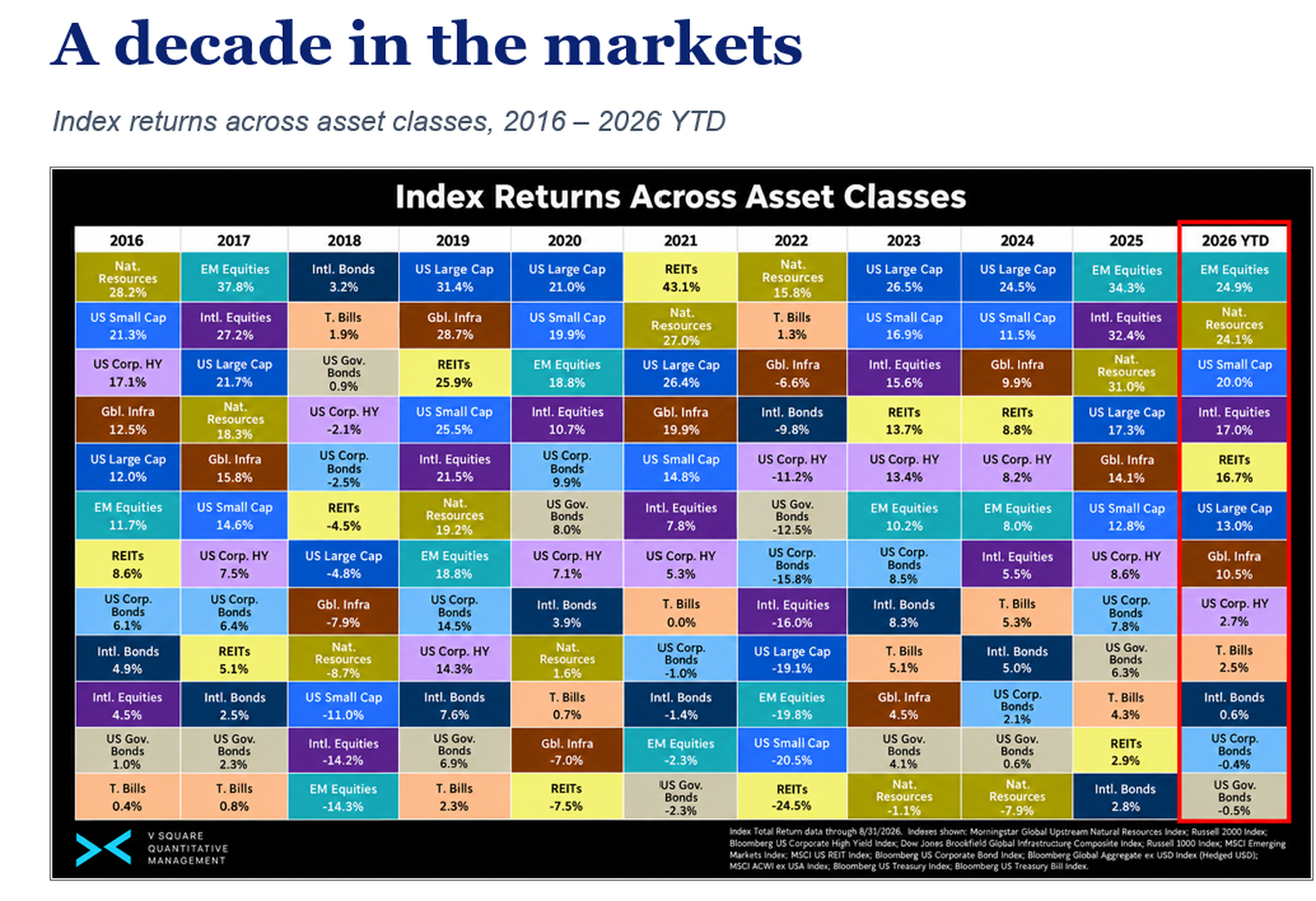
This chart is for illustrative purposes only. Other indexes are available. It is not possible to invest directly in an index. Index returns do not reflect any management fees, transaction costs or expenses. Past performance does not guarantee future performance. The information and opinions contained herein are for informational purposes only, do not purport to be full or complete, do not constitute investment advice and may not be relied on. For more information, please see vsqm.com/disclaimer.