
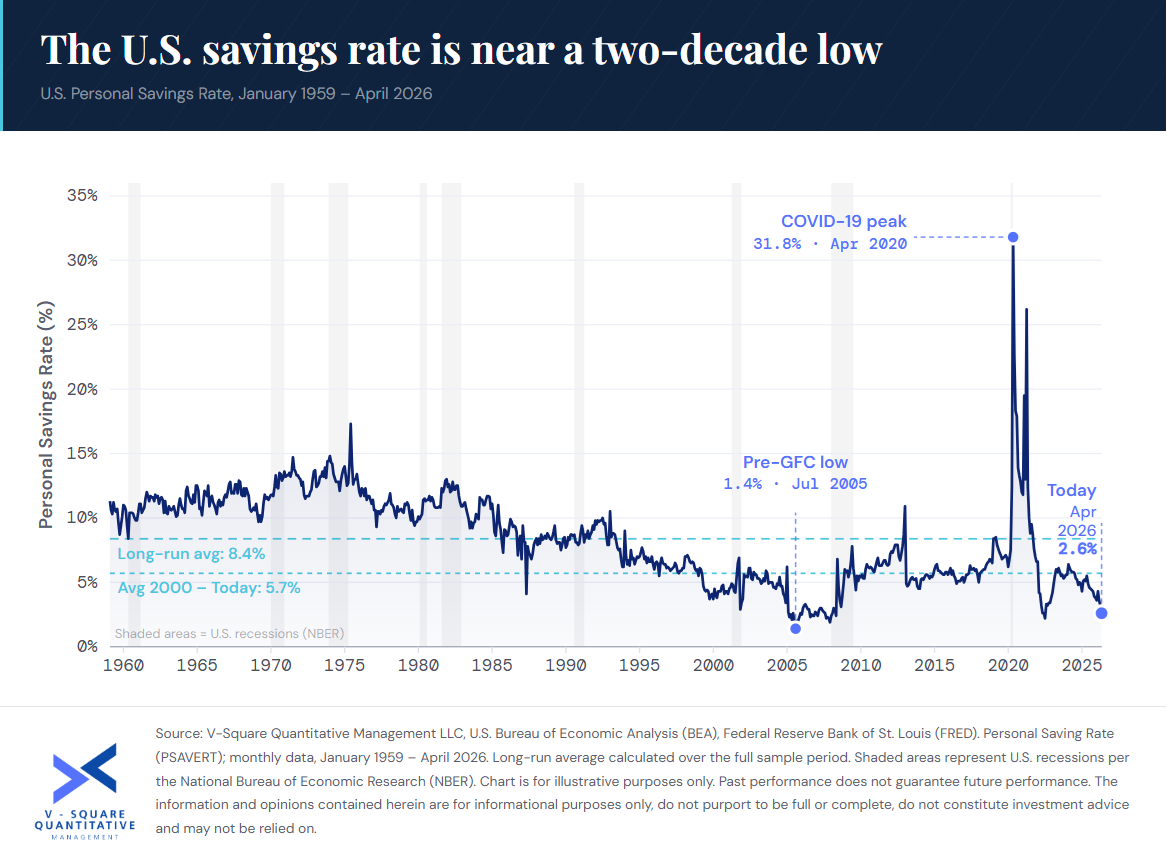
The U.S. personal savings rate fell to 2.6% in April 2026, less than a third of the long-run average of 8.4% recorded since 1959. Outside of a brief stretch before the 2008 financial crisis, Americans have rarely saved this little.
The Bureau of Economic Analysis’ April 2026 data tells a simple story: spending rose 0.5%, while disposable personal income declined 0.1%, naturally translating to a decrease in what Americans can save. This trend of decreasing savings is getting harder to ignore.
The picture is bifurcated in a way that aggregate data can obscure. For investors in consumer-facing companies, the composition of spending matters. While headline consumer spending figures may be stable, it’s noteworthy that higher-income households are supported by asset appreciation rather than broad-based consumer health. Importantly, credit card delinquency rates have climbed to their highest levels in over a decade.
A savings rate near historic lows suggests the consumer buffer is thin. For businesses with exposure to mid- and lower-income households, this is a trend worth watching closely.
How are you thinking about consumer health in your portfolio? We’d love to hear your perspective.
Source: V-Square Quantitative Management LLC, U.S. Bureau of Economic Analysis (BEA), Federal Reserve Bank of St. Louis (FRED). Personal Saving Rate (PSAVERT); monthly data, January 1959 through April 2026. Long-run average calculated over the January 1959 to April 2026 sample period.
This chart is for illustrative purposes only. Other indexes are available. It is not possible to invest directly in an index. Index returns do not reflect any management fees, transaction costs or expenses. Past performance does not guarantee future performance. The information and opinions contained herein are for informational purposes only, do not purport to be full or complete, do not constitute investment advice and may not be relied on. For more information, please see vsqm.com/disclaimer.